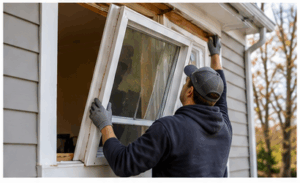
Chicago winters have a way of exposing window problems that are easy to ignore during milder weather.
A window that feels fine in September may start showing drafts, condensation, cold glass, or operational issues once temperatures drop. If your windows are older or already showing signs of wear, fall is a good time to check whether they’re ready for another season.
Start With Drafts
One of the easiest things to notice is cold air around the frame.
Check for drafts near:
- The sash
- The corners of the window
- The meeting rail
- The sill
- The surrounding trim
If you can feel noticeable air movement while the window is fully closed and locked, the seal may no longer be performing as it should.
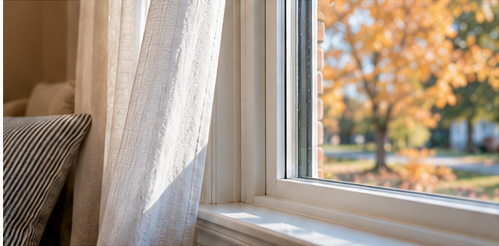
Residential window being checked for drafts before winter.
Look for Condensation Between the Panes
Condensation on the interior surface of glass can sometimes be related to indoor humidity.
Condensation between the panes is different.
Fogging or moisture trapped inside an insulated glass unit can indicate that the seal has failed. Once that happens, the glass may no longer perform the way it was originally designed to.
If this is happening on multiple windows, it may be worth comparing replacement window options.
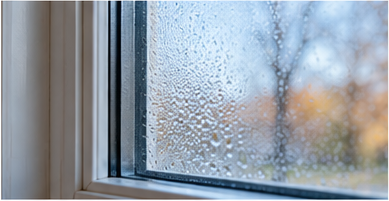
Condensation trapped between residential window panes.
Make Sure Every Window Opens and Locks Properly
Before winter, test each window in the home.
A properly functioning window should open, close, and lock without excessive force.
Watch for:
- Sashes that stick
- Locks that do not line up
- Windows that will not close completely
- Loose hardware
- Gaps between the sash and frame
A window that does not close completely may also have trouble sealing against cold outdoor air.
Check the Exterior Too
Do not only inspect your windows from inside.
Walk around the exterior and look for:
- Damaged or deteriorated trim
- Gaps around the opening
- Water staining
- Cracked materials
- Separation between the window and siding
- Areas where caulk or sealant has failed
These issues can allow moisture to reach areas around the window.
Our guide to window flashing explains why the area around the opening is just as important as the window itself.
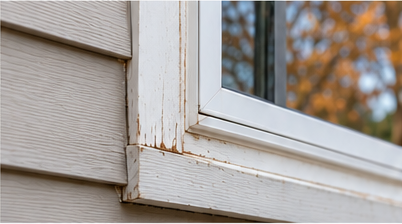
Exterior window trim showing signs of weathering.
Pay Attention to Rooms That Always Feel Colder
If one room consistently feels colder than the rest of the house, the windows may be part of the issue.
Cold glass, air leakage, worn weatherstripping, or older window construction can all affect comfort near exterior walls.
That does not automatically mean every cold room needs new windows, but repeated comfort problems are worth investigating.
Compare the Windows, Not Just Their Age
Older windows are not automatically failing, and newer windows are not automatically problem-free.
What matters is how they are actually performing.
Look at:
- Air leakage
- Glass condition
- Operation
- Locking
- Frame condition
- Exterior trim
- Signs of moisture
If several of these areas are becoming problems, replacement may make more sense than continuing to repair individual issues.
Get Ahead of the Coldest Weather
You do not need to wait until January to find out your windows are struggling.
If you’re already seeing drafts, fogged glass, difficult operation, or exterior deterioration, fall gives you time to understand the problem before the coldest weather arrives.
At Midwest Windows, Siding & Doors, we help homeowners throughout our Chicagoland service areas compare replacement window options and installation approaches.
Call 773-277-2100 or schedule a free consultation to get started.